-
Sholes 1869 residence on Jackson
C.L. Sholes' 1869 residence as listed in 1869 Milwaukee City Directory
-
Sholes 1865 Residence on Division
C.L. Sholes' 1865 residence as listed in 1865 Milwaukee City Directory
-
 QWERTY Curriculum Reading List
 Reading Resources on QWERTY and Technology
-
 QWERTY Curriculum Lesson Plan: Genre and Multimodality
 This is a lesson plan on Genre and Multimodality. It's one of several plans in the QWERTY Curriculum designed to be used in English 102, part of the first-year college writing program at the University of Wisconsin-Milwaukee.
-
 QWERTY Curriculum: Introduction
 This is the introduction to the QWERTY Curriculum designed to be used in English 102, part of the first-year college writing program at the University of Wisconsin-Milwaukee.
-
Matthias Schwalbach's Residence on 10th St (1002 Galena) from 1867
An accomplished clock maker and immigrant from Germany, Matthias Schwalbach was the primary machinist who helped develop the typewriter and perfect many of its prototypes. By 1870, he was working for $3 per day, but held no ownership stake in the enterprise. Around that time he also noted that he did much of the work in his own home.
Until 1871, typewriter prototypes featured miniature piano keyboards with alternating black and white keys, adapted from the Hughes printing telegraph. But in spring 1871 Schwalbach devised a four-tiered keyboard that used small, round disks mounted on stems instead of piano keys, familiar to typists ever since. Regardless of the arrangement of letters on the keys (such as the QWERTY or Dvorak layouts), the "Schwalbach Array," as it should be called, defines almost every keyboard around the world today.
The city directories for Milwaukee for 1867 lists "r. 1002 Galena" at this location as Schwalbach's residence, where he appears to reside well into the 1880s. Today this location is in a parking lot, but formerly would have been at the northwest corner of 10th St. and the former location of Galena St., now Galena Place, which today is slightly further south. If this is the location where Schwalbach was working from home around 1871, you can stand in the exact place where the form of the modern keyboard was born.
-
Samuel W. Soule Residence at 135 W. Wells St. (s.w.c. Wells and W. Water St.) from 1862–68
In 1867, the printer Samuel W. Soule was collaborating with Christopher Latham Sholes on a device to automatically number tickets or pages of booklets at Kleinsteuber's machine shop. While there, they met Carlos Glidden, who later claimed to have suggested that the three men collaborate on creating a mechanical writing machine. In 1868, Soule was listed on a patent for the "Sholes, Glidden & Soule Type-Writer," but by the next year Soule was planning to leave Milwaukee, and played no further role in the enterprise.
The city directories have contradictory information for Soule's residence. In 1862 he is listed at the southwest corner of Wells and W. Water St., which is the corner of W. Wells St. and Plankinton Ave. today. The 1868 city directory lists him at 235 Wells, Room 7; however, according to the 1894 Sanborn maps, there was no 235 Wells. However, the building at the southwest corner of Water and Wells had the address of 235 Water St. It seems likely that the city directory mistook the Water St. number for an address on Wells St. Today, the Germania Building stands on this location. It was built in 1896.
The link below shows a photograph of the south side of Wells St between W. Water St. (Plankinton Ave. today) and Second St. At the left of the picture, the address 103 is visible, which corresponds to the address on Wells for building at the southwest corner, where Soule lived. Around the corner at the left of the photograph would be the side facing what was then W. Water St., and which was numbered 235.
The second link below shows the 1894 Sanborn map page containing the intersection of W. Water St. and Wells St.
-
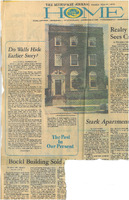 "Do Walls Hide Earlier Story?" Milwaukee Journal (May 27, 1979): 1-2.
 Newspaper article on the residence at 1142 E. Juneau Ave., where Christopher Latham Sholes lived from 1863-1867.
-
C. Kleinsteuber, Machinist and Engraver, at 322 W. State St. (318 State St.)
The inventors of the typewriter did much of their work at Charles Kleinsteuber's machine shop. The shop was a hub for engineers, machinists and inventors, who could rent equipment and bench space for their projects. In 1867, Carlos Glidden was working at Kleinsteuber's on a mechanical spader, while Christopher Latham Sholes and Samuel W. Soule were working on a machine to print serial numbers on tickets or page numbers in booklets. The three eventually began working together on a mechanical writing machine, and produced their first prototype at Kleinsteuber's in September 1867.
The original building housing Kleinsteuber's was destroyed in 1889, when the Anton Kuolt Schlitz Brewery Saloon was constructed on the same location. That building remains on the location today.
-
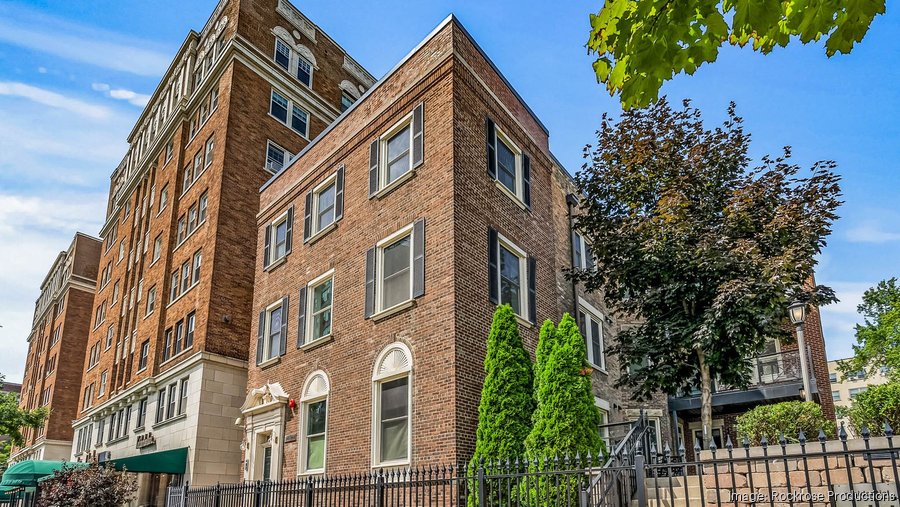 Christopher Latham Sholes House, 1042 E. Juneau Ave. (302 Division), 1863–68
 Christopher Latham Sholes lived at this location from 1863 to 1868, when he sold the house. After two other owners, Henry L. Palmer, the president of Northwestern Mutual Life, purchased the property. His son Charles Palmer inherited the property in 1915, and renovated it extensively.
By the time we have reliable records of the property, there were two buildings on the property. The surviving building facing E. Juneau Ave. currently has a brass plaque labelled "Sholes House," and has contained three separate apartments for more than a century. Today, it seems an extraordinarily large building for a man of Sholes's modest means to have owned. However, a second and much smaller single-family house formerly existed on the back of the property, accessible by the alley between the apartment building and the Knickerbocker Hotel to the west. When Charles Palmer lived at this location after 1915, he seems to have lived in that single-family property at the back of the lot, which he renovated to add a garage for an automobile. However, when Sholes lived at this location, if a second building existed on the lot it was likely not a single family house but a horse stable: the 1894 Sanborn Map indicates that it is a stable by drawing an X building. As a result, it seems clear that even though later occupants at this location lived in the house at the rear of the lot, Sholes lived in the larger building that survives on the front of the lot to this day.
The formidable size of the building today might seem implausibly large for a modest newspaper editor like Sholes to own in the 1860s, but the building underwent many renovations after Sholes departed. See the story linked below from the Milwaukee Journal about the history of the property, which speculates that the original wood-frame building was later sheathed in brick during Charles Palmer's 1932 renovation. The Sanborn Map corroborates this. Even though it indicates that the building is brick, it also annotates it with the word "Framed," suggesting wood frame construction too. The 1878 lithograph in the Milwaukee Journal article shows a much more modestly sized two-story building before its subsequent renovations and expansions. When Sholes lived at this address, he would have inhabited a much smaller and more modest house.
The Wisconsin Historical Society page for this property, also linked below, notes that the current building was constructed in 1932, but this refers to the date of what was likely Palmer's extensive renovation or reconstruction.
-
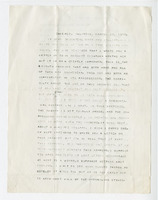 Letter, Sherman Booth to Mary and Lillian Booth, Chicago, IL, 1870
 This extraordinary letter was written in 1870 by the abolitionist Sherman Booth (1812-1904). Booth moved to Milwaukee in 1848 as the editor of the Milwaukee Freeman, an abolitionist newspaper. In 1867 Booth moved to Chicago with his third wife, Augusta Smith, who he refers to in the letter. While there, James Densmore--the main financial backer of the early typewriter enterprise--appears to have delivered an early typewriter prototype to Booth, on which he wrote this letter, four years before the final version of the typewriter went on sale to the public.
There is a telling typo near the end of the letter that helps us understand what sort of machine Booth was using. Early prototypes had piano keyboards, with the letters A-M from left to right on the black keys, and the letters N-Z right to left on the white keys. When Booth mis-spells "wife" as "whfe," he makes an error that would be unlikely on a QWERTY keyboard, where H and I are on different rows and separated by one key. But on the early prototypes with piano keyboards, H and I would have been on adjacent black keys, and so much easier to mistake.
The link below shows the surviving keyboard of an early prototype held by the Milwaukee Public Museum, which likely resembles the one that Booth would have used. Only its keyboard and lower frame survive; the mechanism for imprinting letters was removed and perhaps repurposed for subsequent prototypes.
Booth also notes that he had written a similar letter on an even earlier prototype eighteen months earlier, which would have been on a very early prototype. This letter is lost, but could tell us a great deal about the capabilities of the earliest prototypes. How Booth and Densmore came to know each other at this period is not known, but Densmore spent the late 1860s and early 1870s putting machines in the hands of many testers, so he may have sought out Booth as journalist and editor likely to be interested in new writing techniques.
